Search This Blog

Saturday, April 30, 2011

Who's is your SRM?

The covers of GOLF DIGEST and GOLF magazine feature Tiger, Phil, Dustin Johnson, and Bubba who ever just moved into number one in the world. All tour pros are great and have swings unique to their athleticism. It is easy to marvel at these swings, try to copy their positions, and analyze why their action is ideal or unconventional, but what swing shape do you aspire to recreate.

I believe it is critical to have a Swing Role Model; why reinvent the wheel?

A Swing Role Model can ingrain an image of the correct path to and from the ball by way of visual learning. Using your imagination to envision a specific position may be a more powerful swing thought for you on the practice tee than "do this", "don't do that", "turn this way", "maintain a ___", etc.

A SRM helps to sort out the profusion of "golf tips" available in the scuttlebutt of your weekend 4-some. In measuring your swing against a pro you should ask yourself is my SRM working on what I am trying. For example under Sean Foley Tiger is trying to keep his left ear on the ball throughout the backswing, if Tiger is your SRM, then you can ignore advise on turning your left shoulder over your right toe. Or if Ben Hogan is your man then you better be starting with the ability to hook the ball or Hogan's 5 Lesson: The Modern Fundamentals of Golf  will having you slicing it off the course in  no time.

My swing model is Stuart Appleby:
I have always struggled to complete a lateral move behind the ball and into the left (in fact I believe that this move should be avoided); like Appleby I naturally make an aggressive hitting motion at impact, and I have a similar build to Appleby for these reason Stews my guy.

In selecting a swing model it is important to consider 3 things:
  1. Your natural athletic tendency even if its a technical swing flaw.
  2. Your build v. the SRM's build.
  3. The consistency with which the model swings; ie don't copy Bubba, Big John, or Rickie Fowler.

So.....Who you got?

Wednesday, April 27, 2011

A Moving Swing Arc

Slippy Bone and Harmony,

Here is a diagram that shows the importance of working the shaft of the club up during the takeaway, now all great golfers move the arc behind the ball to some degree but they do this while working the club up and on plane to the plane set at address, they then move their lower body forward past the ball in transition. I thought the engineer in you would appreciate this diagram, but maybe I should have sent it to Barb first so you could copy it.

Your power source for the takeaway

Reading the April issue of Golf Digest Tiger's new guru, Sean Foley, describes the role of the legs as "shock absorbers" that "absorb the motion you are about to create" I think this is spot on but it begs the question; what motion are your legs supporting?

In order to complete the takeaway on plane the shoulders must power the first third of the swing. Turning parallel to your belt the clubhead will move exponentially to the distance the shoulders travel. Once you begin to turn the shoulders try to keep your right shoulder (for righties) as far away from your left knee as possible. This will stabilize your lower half and allow you to maintain right knee flex. That's correct by focusing on right shoulder left knee separation you will maintain the proper right knee flex
.
Any thoughts?

Ppms
Sent on the Sprint® Now Network from my BlackBerry®

Monday, April 25, 2011

Slippy FOO!

Happy Birthday Sip

Here is yours swing, you need to get the club working up immediately after the ball, keep practicing the drill I gave you, placing a tee 10 inches behind the ball. And forget "slow and low" - The Golden Bear


Train in Training

Train
follow youtube link for video


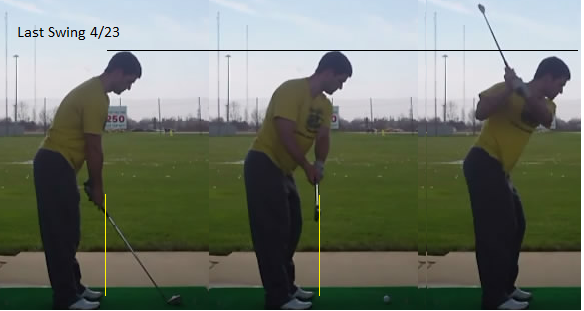
Your swing comes to you pretty naturally and you have great body action, checkout  how well you hold your depth indicated by the white line on your butt. Maintaining depth is important to the golf swing because it allows the club to work back in front of the body without the obstruction of the body. Golfers who struggle with this move lose their spine angle through impact clearly by your final frame you have maintained your spine angle which allows you to return the club dead on plane.


Gorillaswing

How does this sequence look for you?

I took your last frame and moved it to three

Gorilla 1st lesson - Takeaway-4/23

Gorillaswing


video at youtube

Well Gorillaswing I don't think you are cured yet but I know that you're not as far off as you think. You worked on setup and takeaway and will see that these adjustments in this early stage of your action have already created counter balancing changes in the backswing for the positive.

Stepping back, there are 5 stages to the golf swing: setup, takeaway, backswing, transition, and recoil. Setup is static and occurs prior to address, the setup creates the required angles for you to coil the body and club together away from the target on plane. The takeaway is summarized by its completion when the hands have reached belt high (when viewed from down the line). Backswing, transition, and recoil were not discussed but we can see the results of an improved setup and takeaway in the photos of your completed backswing.